The 50/30/20 Budget: How It Works, With a Google Sheets Example | Efficiency Sheets
The 50/30/20 Budget: How It Works, With a Google Sheets Example
Split your take-home pay into needs, wants and savings. What goes in each bucket, the Google Sheets formulas, and what to do when your numbers don't fit.
Efficiency Sheets ·
The 50/30/20 rule is the simplest budget that still works. You split your take-home pay three ways:
50% for needs: things you have to pay
30% for wants: things you choose to pay for
20% for savings and debt: your future
It was popularized by Elizabeth Warren and Amelia Warren Tyagi in their 2005 book All Your Worth. It's popular because you only have to watch three numbers instead of thirty categories.
A quick example
Say you take home $4,000 a month after taxes.
Bucket
Share
Monthly amount
Needs
50%
$2,000
Wants
30%
$1,200
Savings and debt
20%
$800
Always use take-home pay, the amount that lands in your account. If money for retirement or health insurance comes out of your paycheck before you see it, see the FAQ below.
What counts as a need
A need is something you'd still have to pay if you lost your job tomorrow:
Rent or mortgage
Utilities, phone and internet
Groceries (not restaurants)
Insurance: health, car, renters or home
Transportation to work: car payment, gas, transit pass
Childcare
Minimum payments on debts
Questions
Is 50/30/20 based on gross or net income?
Net, meaning your take-home pay after taxes. Using gross income makes every bucket look bigger than the money you actually have.
What if retirement comes out of my paycheck automatically?
You can add that contribution back to your take-home pay and count it toward your 20%. Or leave it out and treat the 20% as savings on top of it. Pick one approach and stick with it.
Are debt payments a need or savings?
Minimum payments are a need. Anything you pay above the minimum goes in the 20% savings and debt bucket.
Is 50/30/20 good for beginners?
Yes. It's one of the easiest ways to start, because you only track three totals. Many people move to a more detailed budget once the habit sticks.
The test is the bill, not the brand. Groceries are a need. The more expensive grocery store is partly a want.
What counts as a want
Everything you could cut without real hardship:
Eating out and takeout
Streaming services and subscriptions
Shopping, hobbies and gym memberships
Travel and concerts
Upgrades, like a newer phone than you need
Wants aren't bad. The 30% is there so you can enjoy your money without guilt.
What counts as savings and debt
Emergency fund
Retirement contributions you make yourself
Saving for a goal: a house, a car, a trip
Debt payments above the minimum
Minimum payments are a need because you have to make them. Anything extra is a choice to get ahead, so it goes in the 20%.
Setting it up in Google Sheets
Put your take-home pay in cell B1. Then calculate each target:
Needs: =B1*0.5
Wants: =B1*0.3
Savings and debt: =B1*0.2
Next, list every expense with its amount in column B and a tag in column C: Need, Want or Save. To make tagging quick, select column C and use Data → Data validation to turn it into a dropdown with those three options.
Now total each bucket with SUMIF:
=SUMIF(C:C,"Need",B:B)
Change "Need" to "Want" or "Save" for the other two. To see what share of your income each bucket really takes, divide by your income and format the cell as a percentage:
=SUMIF(C:C,"Need",B:B)/B1
When your numbers don't fit
Many people find their needs take more than 50%, especially in expensive cities or right after a move. That doesn't mean the method fails. It tells you something.
Needs at 60% or more? Use 60/20/20 for now: take the extra from wants, not from savings. Then look at your biggest need, which is usually housing or a car, and decide whether it fits long term.
Paying off high-interest debt? Try 50/20/30, moving 10% from wants to debt until the cards are gone.
Saving for something big? Same idea: shrink wants for a set number of months.
The exact percentages matter less than having a split you chose on purpose.
Using it with a full budget
50/30/20 tells you how much goes into each bucket. A detailed budget tells you where it goes inside the bucket. They work well together: set your three targets, then plan the individual lines so they add up to them.
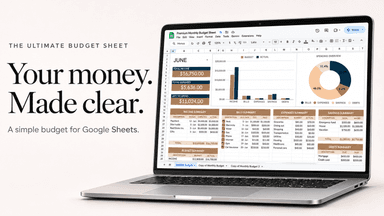
The Ultimate Budget Sheet has separate sections for bills, expenses, savings and debts. You set a budget for each line, and it shows what's left to spend and how actual spending compares, so it's easy to see when one bucket starts to grow.