
Zero-Based Budgeting vs. 50/30/20: Which One Fits You
Two popular ways to budget, compared side by side: how each works, how much effort it takes, and who it suits best.
Efficiency Sheets ·
Zero-based budgeting and the 50/30/20 rule are the two methods people ask about most. Both work. They suit different people, and the right one is the one you'll still be using in three months.
How zero-based budgeting works
You give every dollar of your income a job until there's nothing left unassigned. Income minus everything you plan for equals zero.
That doesn't mean you spend everything. Savings and extra debt payments are jobs too. "Zero" only means no money is left floating without a plan.
With $4,000 of take-home pay, a zero-based month might look like this:
| Line | Amount |
|---|---|
| Rent | 1,400 |
| Utilities and phone | 220 |
| Groceries | 450 |
| Gas and transit | 180 |
| Insurance | 160 |
| Eating out | 200 |
| Subscriptions | 45 |
| Shopping and personal | 150 |
| Gifts (set aside monthly) | 50 |
| Emergency fund | 400 |
| Retirement | 300 |
| Extra credit card payment | 245 |
| Fun money | 200 |
| Left to assign | 0 |
How 50/30/20 works
You split your take-home pay into three buckets: 50% for needs, 30% for wants, and 20% for savings and debt. Within each bucket you can spend however you like, as long as the bucket's total holds. The 50/30/20 guide covers it in detail.
Side by side
| Zero-based | 50/30/20 | |
|---|---|---|
| What you plan | Every category | Three totals |
| Time per month | 1 to 2 hours | About 30 minutes |
| Flexibility | Low: changes mean moving money between lines | High: anything inside a bucket is fine |
| Catches small leaks | Yes | Not really |
| Best for | Tight months, paying off debt, irregular income | Steady income, a first budget, people who hate detail |
Choose zero-based if
- Money is tight and every dollar matters right now
- You're paying down debt and want to find every extra dollar
- Your income changes month to month, so you plan each month from what actually came in
- You like detail and find it satisfying to see everything accounted for
Choose 50/30/20 if
- This is your first budget
- Your income is steady and you mostly want guardrails
- Detailed tracking made you quit before
- You already save regularly and just want a quick check that you're on track
Or use both
Many people end up combining them. Use 50/30/20 to set the big targets once a year: how much should go to needs, wants and savings. Then plan each month zero-based, filling in the lines so they add up to those targets.
Doing either one in Google Sheets
For zero-based, list every line with its planned amount and keep one cell that shows what's still unassigned. If your income is in B1 and your lines are in B3 to B30:
=B1-SUM(B3:B30)
Keep adjusting until that cell reads 0.
For 50/30/20, tag each line Need, Want or Save and total each bucket with SUMIF. The 50/30/20 guide has the exact formulas.
The Ultimate Budget Sheet works for both. It shows Left to Spend at the top: aim for zero if you budget zero-based, or check your section totals against your three targets if you use 50/30/20.
Questions
Does zero-based budgeting mean I spend all my money?
No. Savings and extra debt payments count as jobs for your money. Zero means nothing is left without a plan, not that your account is empty.
Which method is better for paying off debt?
Zero-based usually works better, because planning every line helps you find extra money to put toward the debt each month.
Can I switch methods later?
Yes. A common path is to start with 50/30/20 to build the habit, then move to zero-based when you want more control, or the other way around when detailed tracking starts to feel like a chore.
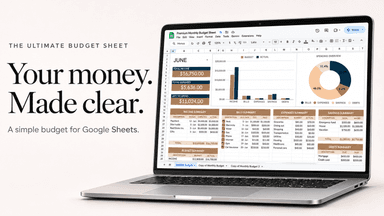
The Ultimate Budget Sheet
$11.97 · one-time · instant download